Skin Service
VectorLift® BY DR. NIDA
Non-Surgical Eyebrow Lifting • Upper-Eyelid Rejuvenation
Non-Surgical Eyebrow Lifting
• Upper-Eyelid Rejuvenation
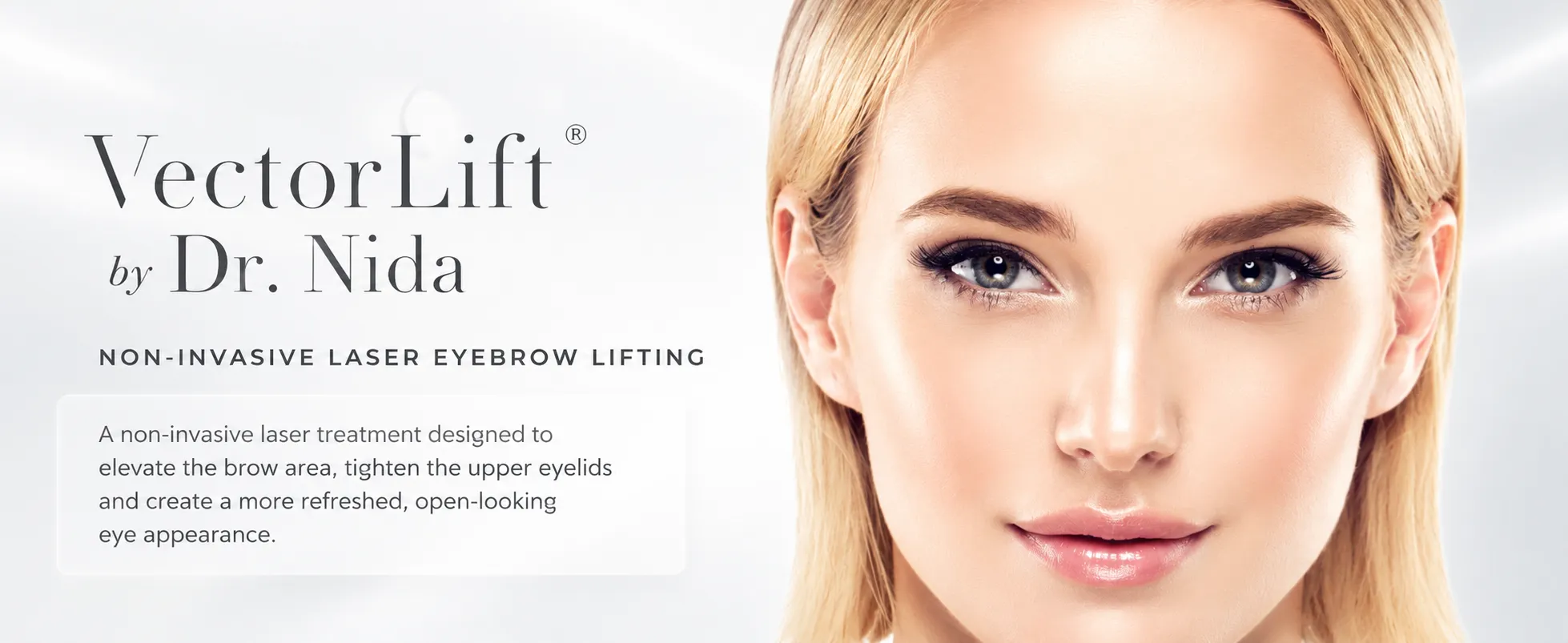
A non-invasive three-step Fotona laser protocol designed to elevate the eyebrow tail,
tighten upper-eyelid tissue and create a more refreshed, open-looking upper face.
A non-invasive three-step Fotona laser protocol designed to elevate the eyebrow tail, tighten upper-eyelid tissue and create a more refreshed, open-looking upper face.
INTRODUCTION
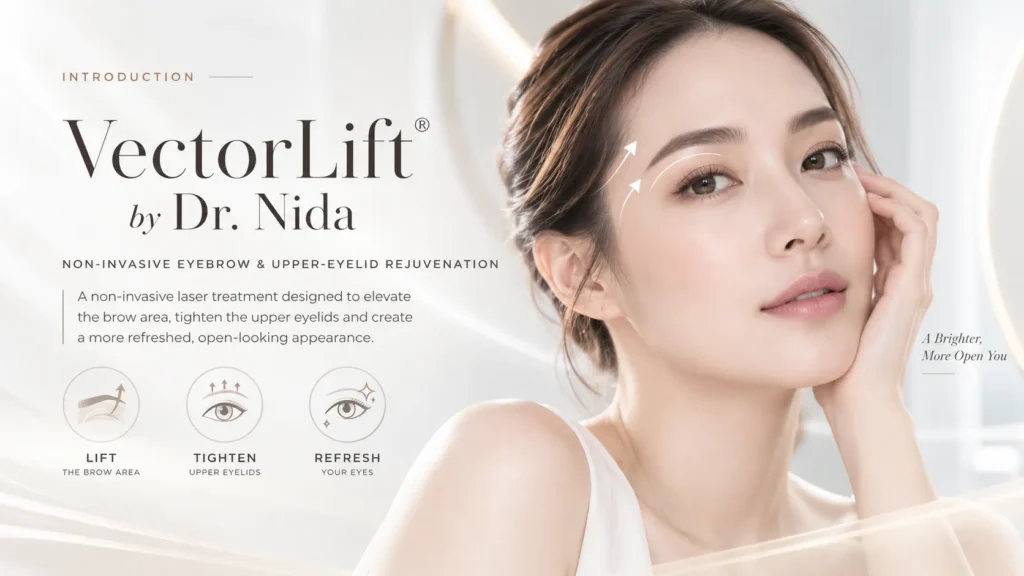
The position of the eyebrow and the firmness of upper-eyelid tissue can significantly change facial expression. Even mild descent of the brow tail may make the eyes look heavier or more tired, while early eyelid laxity can reduce the open appearance of the upper face. VectorLift® is Fotona’s three-step laser protocol created specifically for periocular and brow aesthetics. The treatment is designed to elevate the eyebrow tail and tighten tissue above the upper eyelid without surgery. At Nida Esth’, the goal is not an exaggerated arch, but a natural direction of lift that remains harmonious with the rest of the face.
The position of the eyebrow and the firmness of upper-eyelid tissue can significantly change facial expression. Even mild descent of the brow tail may make the eyes look heavier or more tired, while early eyelid laxity can reduce the open appearance of the upper face. VectorLift® is Fotona’s three-step laser protocol created specifically for periocular and brow aesthetics. The treatment is designed to elevate the eyebrow tail and tighten tissue above the upper eyelid without surgery.
At Nida Esth’, the goal is not an exaggerated arch, but a natural direction of lift that remains harmonious with the rest of the face.
WHAT’S THE EXPERT SAY?
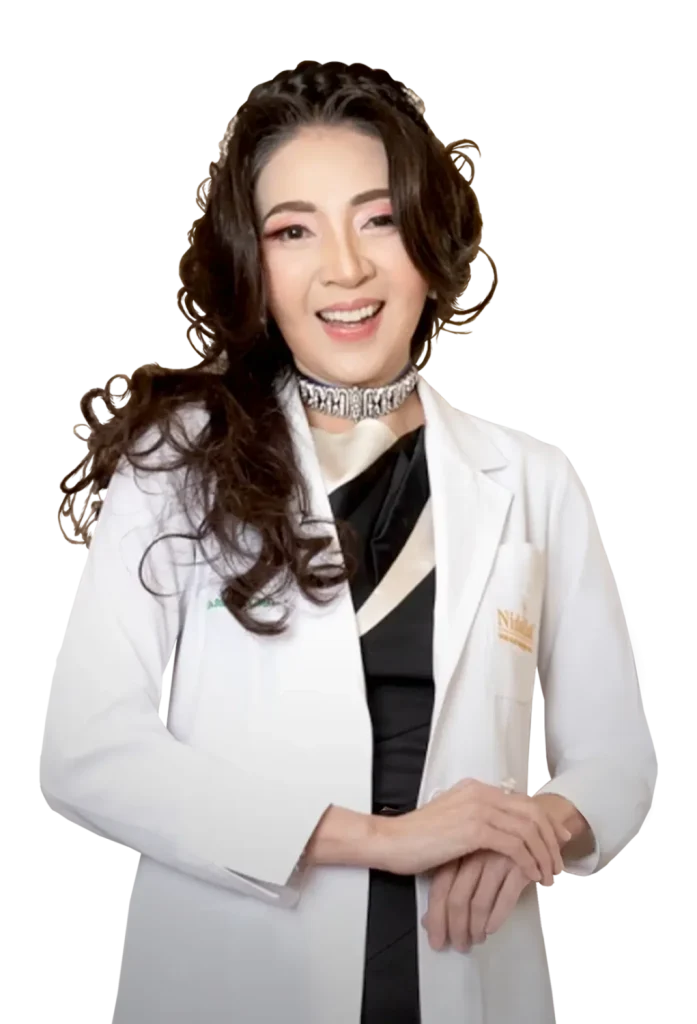
“Around the eyes, a few millimeters can change the whole expression. I prefer to open the eye area in a subtle way rather than forcing the brow into a high arch. VectorLift® is useful when the concern is mild brow descent or early upper-eyelid laxity and the patient wants a non-surgical option that still respects natural facial anatomy.”
— Dr. Nida
Read More
At Nida Esth’ International, treatment design is physician-led and individualized. The medical team has received professional recognition through Global Health Aesthetic / Global Health Asia Pacific and HELLO! Thailand awards in aesthetic medicine, laser technology and cosmetic care. These recognitions are part of the medical centre’s background and are not a guarantee of any individual treatment result.
Nida Esth
Add us to get
exclusive offers.
Exclusively for clients with a scheduled appointment
who have completed the Skin Treatment Program.
* Terms and conditions apply.
WHAT IS IT?
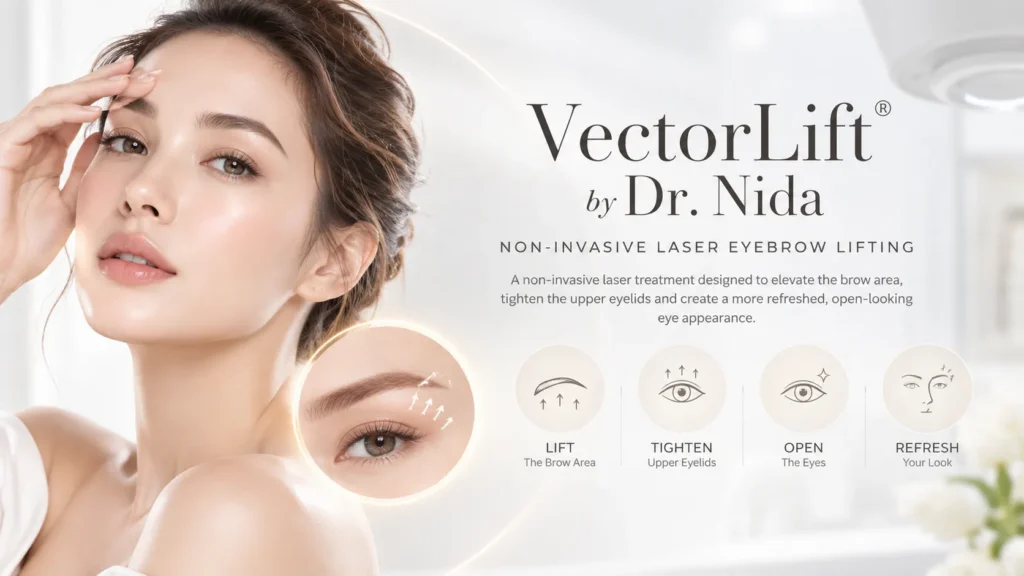
VectorLift® is Fotona’s three-step protocol for non-invasive eyebrow lifting and upper-eyelid rejuvenation. It enhances periocular and brow aesthetics through targeted laser-induced collagen contraction and remodeling. Unlike a surgical brow lift, there are no incisions, tissue excision or fixation. It is therefore best understood as a subtle rejuvenation treatment for suitable degrees of laxity rather than a substitute for surgery in patients with significant excess skin or major brow descent.
Personalization matters because the same laser platform can create different biological effects when pulse duration, energy, spot size, treatment density and number of passes change. Two patients may describe a similar concern but have very different skin thickness, anatomy, pigmentation tendency, previous procedures or tolerance for downtime. A physician therefore needs to select the treatment endpoint rather than simply copying a standard setting from one patient to another.
VectorLift® is Fotona’s three-step protocol for non-invasive eyebrow lifting and upper-eyelid rejuvenation. It enhances periocular and brow aesthetics through targeted laser-induced collagen contraction and remodeling. Unlike a surgical brow lift, there are no incisions, tissue excision or fixation. It is therefore best understood as a subtle rejuvenation treatment for suitable degrees of laxity rather than a substitute for surgery in patients with significant excess skin or major brow descent.
Personalization matters because the same
laser platform can create different biological effects when pulse duration, energy, spot size, treatment density and number of passes change. Two patients may describe a similar concern but have very different skin thickness, anatomy, pigmentation tendency, previous procedures or tolerance for downtime.
A physician therefore needs to select the treatment endpoint rather than simply copying a standard setting from
one patient to another.
HOW DOES IT WORK?
Forehead and Brow Tightening
Controlled thermal laser energy is used in the forehead and brow region to stimulate collagen contraction and support elevation of the tissue above the eye. Treatment vectors are selected according to the natural brow shape and direction of descent.
Eyebrow-Tail Elevation
The second step focuses more specifically on the lateral brow. By treating along selected vectors,
the protocol aims to improve eyebrow-tail position and create a slightly more open upper-eye appearance.
The second step focuses more specifically on the lateral brow.
By treating along selected vectors, the protocol aims to improve eyebrow-tail
position and create a slightly more open upper-eye appearance.
The second step focuses more specifically on the lateral brow. By treating along selected vectors, the protocol aims to improve eyebrow-tail position and create a slightly more open upper-eye appearance.
Upper-Eyelid Rejuvenation
The final step targets upper-eyelid and periocular tissue with parameters suitable for this delicate region.
Collagen remodeling can improve firmness and reduce the heavy appearance associated with early laxity.
The final step targets upper-eyelid and periocular tissue with parameters suitable
for this delicate region. Collagen remodeling can improve firmness and reduce the
heavy appearance associated with early laxity.
The final step targets upper-eyelid and periocular tissue with parameters suitable for this delicate region. Collagen remodeling can improve firmness and reduce the heavy appearance associated with early laxity.
WHAT RESULTS CAN I EXPECT?
WHAT RESULTS
CAN I EXPECT?
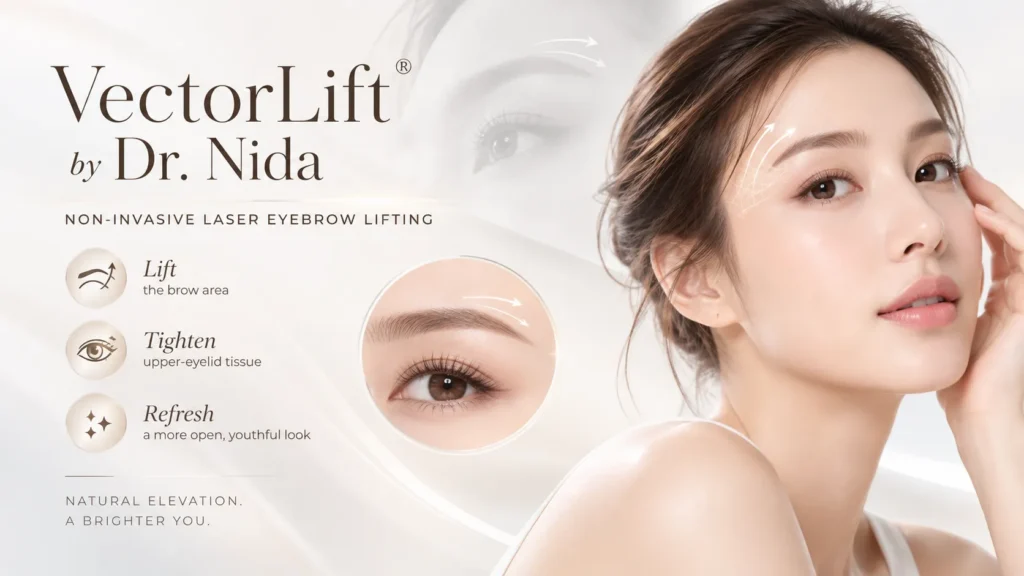
The aim is improvement rather than a standardized transformation. Some changes may be appreciated relatively early, while collagen remodeling or tissue adaptation usually develops more gradually. The final result depends on baseline anatomy, age, skin or tissue quality, treatment parameters and individual biological response.
- Subtle elevation of the eyebrow tail
- More open and refreshed-looking eyes
- Improved firmness of upper-eyelid skin
- Smoother-looking forehead and brow region
- Natural-looking upper-face rejuvenation without surgery
- Subtle elevation of the eyebrow tail
- More open and refreshed-looking eyes
- Improved firmness of upper-eyelid skin
-
Smoother-looking forehead
and brow region -
Natural-looking upper-face
rejuvenation without surgery
Long-term results are influenced by more than the treatment session itself. Sun exposure, smoking, skincare, hormonal changes, age, nutrition, sleep and future aging all affect tissue quality. Follow-up allows the physician to compare photographs, assess response and decide whether a protocol should be repeated, modified or stopped. Maintenance should therefore be individualized rather than scheduled automatically for every patient.
Nida Esth
Add us to get
exclusive offers.
Exclusively for clients with a scheduled appointment
who have completed the Skin Treatment Program.
* Terms and conditions apply.
WHO IS IT FOR?
An ideal candidate is someone whose concern matches the mechanism of the treatment and who has realistic expectations about a non-surgical laser procedure.
A medical consultation is important when there is significant laxity, active disease, pregnancy, recent procedures, medications affecting healing or other clinical factors.
• Mild eyebrow-tail descent
• Early upper-eyelid laxity
• Heavy or tired-looking upper eyes
• Patients wanting a subtle non-surgical brow refresh
• Patients without major excess eyelid skin requiring surgery
A responsible treatment plan also considers what the laser is not designed to correct. Significant excess skin, advanced structural descent, major volume deficiency, active skin disease or other medical conditions may require a different approach. Defining these boundaries helps prevent over-treatment and allows the physician to decide whether laser rejuvenation, injectables, minimally invasive procedures or surgery is the more appropriate tool for the severity and origin of the concern.
An ideal candidate is someone whose concern matches the mechanism of the treatment and who has realistic expectations about a non-surgical laser procedure. A medical consultation is important when there is significant laxity, active disease, pregnancy, recent procedures, medications affecting healing or other clinical factors.
• Mild eyebrow-tail descent
• Early upper-eyelid laxity
• Heavy or tired-looking upper eyes
• Patients wanting a subtle non-surgical brow refresh
• Patients without major excess eyelid skin requiring surgery
A responsible treatment plan also considers what the laser is not designed to correct. Significant excess skin, advanced structural descent, major volume deficiency, active skin disease or other medical conditions may require a different approach. Defining these boundaries helps prevent over-treatment and allows the physician to decide whether laser rejuvenation, injectables, minimally invasive procedures or surgery is the more appropriate tool for the severity and origin of the concern.
An ideal candidate is someone whose concern matches the mechanism of the treatment and who has realistic expectations about a non-surgical laser procedure. A medical consultation is important when there is significant laxity, active disease, pregnancy, recent procedures, medications affecting healing or other clinical factors.
• Mild eyebrow-tail descent
• Early upper-eyelid laxity
• Heavy or tired-looking upper eyes
• Patients wanting a subtle
non-surgical brow refresh
• Patients without major excess
eyelid skin requiring surgery
A responsible treatment plan also considers what the laser is not designed to correct. Significant excess skin, advanced structural descent, major volume deficiency, active skin disease or other medical conditions may require a different approach. Defining these boundaries helps prevent over-treatment and allows the physician to decide whether laser rejuvenation, injectables, minimally invasive procedures or surgery is the more appropriate tool for the severity and origin of the concern.
STEPS OF TREATMENT
STEP 1
Brow, eyelid and orbital assessment
STEP 2
Photographic evaluation and vector planning
Photographic evaluation
and vector planning
STEP 3
Forehead and brow thermal stimulation
STEP 4
Targeted brow-tail elevation step
STEP 5
Upper-eyelid rejuvenation
STEP 6
Cooling and eye-area aftercare
STEP 7
Follow-up assessment of symmetry and response
Follow-up assessment of
symmetry and response
Exact preparation and aftercare vary with the selected parameters. Patients should disclose recent procedures, medications and relevant medical history before treatment. After laser procedures, avoiding unnecessary irritation and following physician-directed aftercare are important parts of recovery.
PERSONALIZED TREATMENT PLANNING
Patient comfort and safety are also part of treatment design. Sensation can range from gentle warmth to brief heat or a light snapping feeling depending on the mode.
Comfort measures can be used when appropriate, but the goal is not simply to use the highest possible energy.
The physician balances tolerability with an appropriate biological endpoint and the patient’s recovery needs.
At Nida Esth’, treatment planning is intended to be individualized rather than device-led. The program name describes a technology platform,
but the clinical result depends on how the physician selects treatment zones, energy, passes and combinations.
This is why consultation, photography and follow-up are part of the treatment process rather than optional extras.
Patient comfort and safety are also part of treatment design. Sensation can range from gentle warmth to brief heat or a light snapping feeling depending on the mode. Comfort measures can be used when appropriate, but the goal is not simply to use the highest possible energy. The physician balances tolerability with an appropriate biological endpoint and the patient’s recovery needs.
At Nida Esth’, treatment planning is intended to be individualized rather than device-led. The program name describes a technology platform, but the clinical result depends on how the physician selects treatment zones, energy, passes and combinations. This is why consultation, photography and follow-up are part of the treatment process rather than optional extras.
FAQ
Is VectorLift® a surgical brow lift?
No. It is a non-invasive laser protocol. The degree of lifting is therefore more subtle than surgery and depends on baseline anatomy and laxity.
Can it treat hooded eyelids?
It may improve mild laxity and firmness, but significant hooding caused by substantial excess skin may require blepharoplasty or another surgical approach.
Will the eyebrow look unnaturally high?
Treatment vectors can be customized to the existing brow shape. The aim is generally subtle elevation and a more open expression, not an exaggerated arch.
Is there downtime?
Temporary redness, warmth or mild swelling can occur around the treated area, but the protocol is designed as a minimally disruptive non-surgical treatment.
When do results appear?
Some tightening may be appreciated early, while collagen remodeling continues over the following weeks.
Can both brows be treated differently for asymmetry?
Energy and vector planning can be individualized, although perfect symmetry cannot be guaranteed because natural anatomical differences remain.

Related Article
Get the Red Carpet Look with Morpheus 8
Experience the Magic of Morpheus 8: Dr. Nida Brings Hollywood’s Favorite Treatment to Thailand Beyond Beauty by Dr. Nida: Hello everyone, welcome back again to
Ultherapy vs Sofwave: Which Is A Favorite For Hollywood In 2024?
Different Eras Value Different Standard of Beauty; Let’s See How We Can Achieve the Finest Appearance BEYOND BEAUTY BY DR. NIDA Hi everyone, welcome to
’60-Minute’ LunchTime Face Lift. ‘Ageless’Like a Hollywood Star
How a 61-year-old Superstar – Demi Moore Still Look Younger at Such Age? ‘A LunchTime Face Lift for Top Celebrities in Only Just 60 Minutes
REFERENCE
Primary technology reference: official Fotona treatment page.
Reference VectorLift
This website draft is educational marketing content and does not replace individualized medical consultation. Indications, settings, contraindications and expected outcomes should be confirmed by the treating physician.
Primary technology reference: official Fotona treatment page. Reference VectorLift
This website draft is educational marketing content and does not replace individualized medical consultation. Indications, settings, contraindications and expected outcomes should be confirmed by the treating physician.