
Board-Certified Plastic Surgeon & ISAPS Member
CEO & Co-Founder of Nida Esth’ International, Bangkok
In aesthetic medicine, one of the most common misconceptions is also one of the most limiting: the belief that a double chin is simply caused by excess fat.
At first glance, that assumption seems reasonable. Fullness beneath the chin is often seen as a volume problem, and therefore something that should be reduced. But in clinical reality, a double chin is rarely that simple. What appears externally as heaviness under the chin may actually result from several anatomical factors occurring together — including submental fat, skin laxity, weakening jawline support, soft-tissue descent, and inherited lower-face structure.
In many patients, it is not one problem, but multiple layers of change happening at the same time.
That is why modern double chin treatment has evolved so significantly. The most important question today is no longer, What is the best technology for a double chin? The more relevant question is: What is actually creating the fullness, how advanced is it, and what level of correction is needed to restore the jawline naturally?
That is why treatment today should not begin with technology. It should begin with design.
Why Double Chin Is More Complex Than It Looks
The lower face is not an isolated area. The chin, jawline and neck function as one structural unit, and they age together. As collagen declines, tissue support weakens. As skin elasticity changes, the jawline begins to soften. As deeper tissue starts to descend, the clean transition from chin to neck gradually loses its youthful definition.
Even subtle changes can alter the entire lower-face silhouette. A face may appear heavier, less sharp, or slightly older, even when body weight has not changed very much. This is why some patients are surprised to notice a double chin despite being otherwise slim. In such cases, the main issue may not be a large amount of fat, but rather the loss of firmness, support, or contour.
This also explains why two patients may seem to have the same concern, yet require completely different treatment strategies.
One patient may have minimal fat but obvious tissue laxity. Another may have moderate fullness with relatively good skin elasticity. A third may present with heavier volume combined with tissue hanging that extends into the neck. All three may describe the problem as a double chin, but anatomically they are not the same case.
This is where modern aesthetic medicine becomes more sophisticated.
Successful treatment is no longer defined by how many technologies are used, nor by how aggressive a procedure sounds. It is defined by how accurately the problem is analysed and how appropriately the correction is designed for that individual anatomy.
Because the goal is not simply to reduce fullness.
The real goal is to restore a cleaner lower-face contour, a sharper jawline, and a more elegant transition between chin and neck — while preserving natural proportions.
Why Design Comes Before Technology
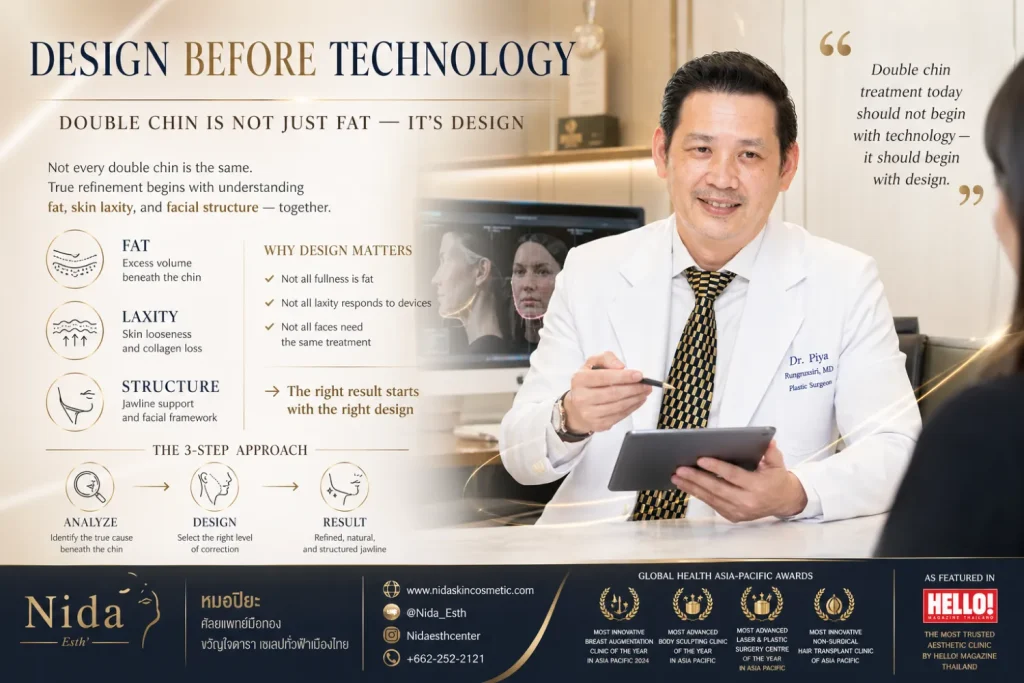
For many years, aesthetic treatment was often approached in a more standardised way. If the concern was fullness, remove fat. If the area looked loose, tighten it. If the result was incomplete, add another device.
But the face does not respond well to oversimplified logic.
A patient whose main issue is laxity may not improve meaningfully with fat reduction alone. A patient with more significant tissue descent may not respond sufficiently to a mild energy-based treatment. And a patient seeking better jawline definition may require both internal support and volume reduction, rather than one or the other alone.
Design, in this context, means diagnosis with intention. It means understanding whether the primary priority is refinement, tightening, lifting, fat reduction, contour restoration, or a combination of these in the right proportion. It means selecting the appropriate level of correction rather than simply reaching for the newest technology.
This shift — from standardised treatment to personalised structural planning — is one of the most important developments in modern aesthetics.
Because a double chin is not a one-technology problem.
It is a structural problem that requires structural thinking.
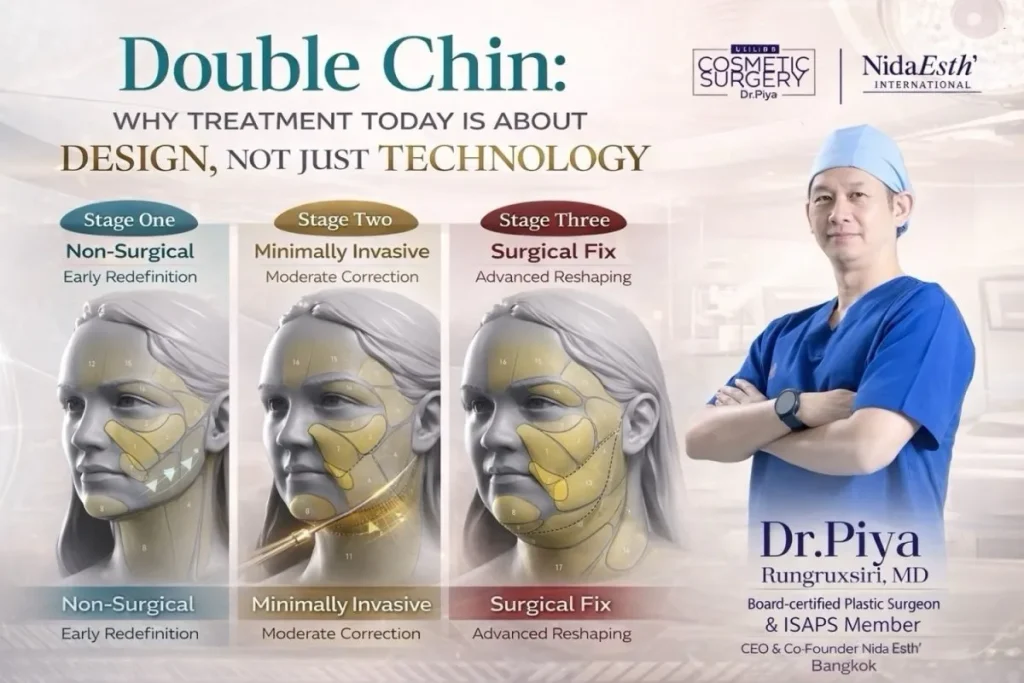
A Three-Stage Approach to Modern Double Chin Correction
In clinical practice, double chin correction can generally be understood across three broad stages of treatment design. These are not rigid categories, but they provide a useful framework for understanding how treatment evolves depending on severity, tissue quality, and anatomy.
Stage One: Non-Surgical Refinement for Early Definition Loss
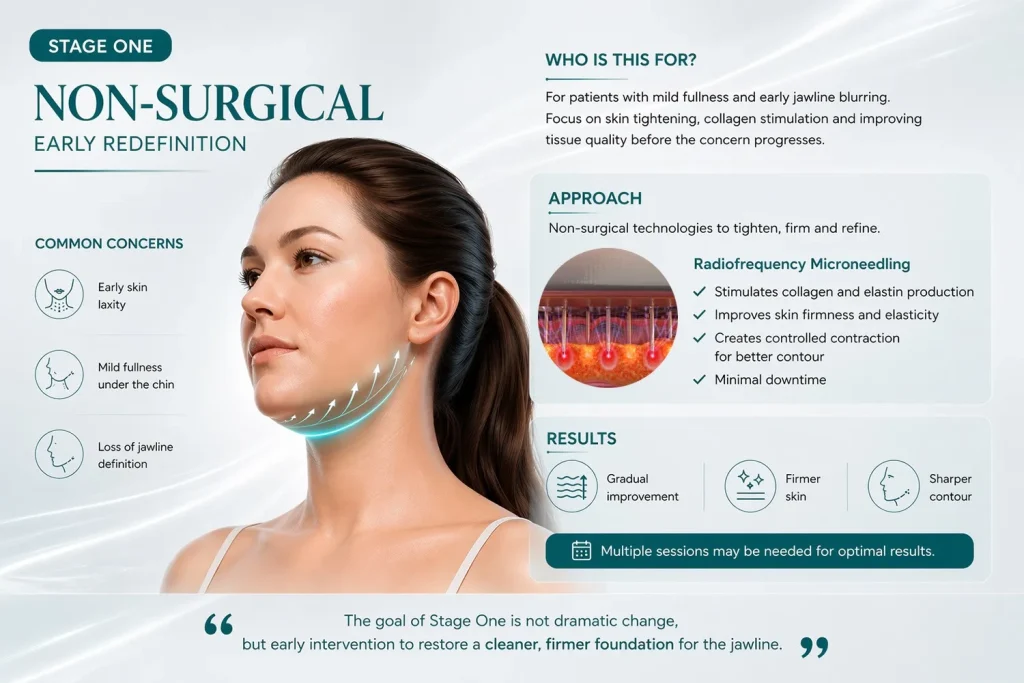
The earliest stage usually involves mild fullness, early jawline blurring, and limited skin laxity. In these patients, the problem is often not a large amount of fat, but the beginning of structural softness.
At this point, aggressive fat removal is usually unnecessary. The treatment goal is not major reduction, but refinement.
Selected energy-based technologies may be used to improve tissue firmness, support collagen remodelling, and create controlled contraction in the lower face. Radiofrequency microneedling, for example, may be considered in patients who need better contour and better tissue quality rather than dramatic debulking.
This level is often appropriate for patients who notice that their jawline looks less sharp in photographs or side view, but whose anatomy does not yet require deeper intervention. Results are generally gradual rather than immediate, and more than one session may be needed depending on tissue quality and the degree of laxity.
The purpose here is not transformation, but interception.
By addressing early structural change intelligently, it may be possible to restore a cleaner contour before the problem becomes more advanced. The improvement may be subtle, but in well-selected patients it can make the face look firmer, fresher, and more refined.
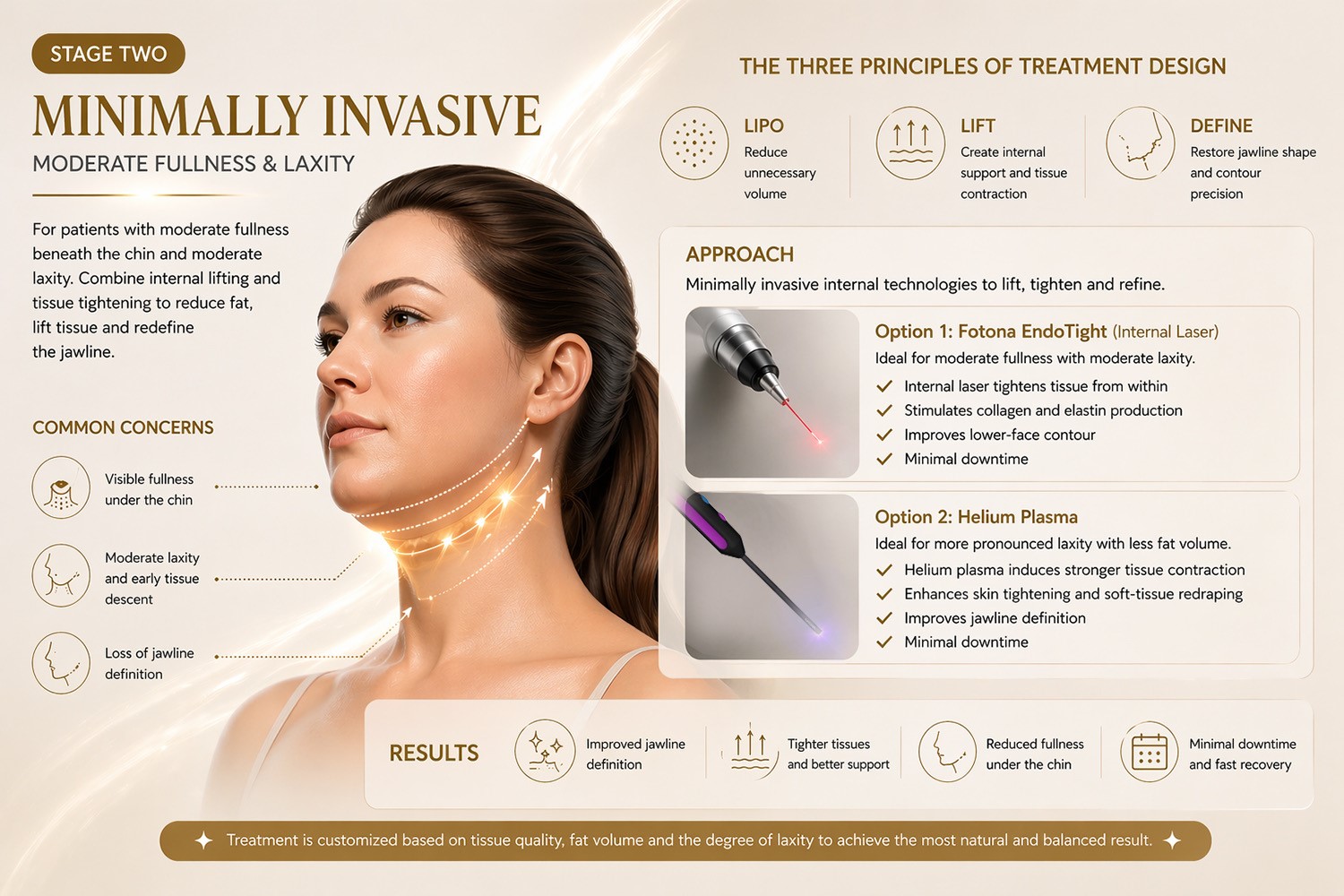
Stage Two: Minimally Invasive Design for Moderate Fullness and Laxity
As the double chin becomes more visible and the jawline begins to lose shape more clearly, treatment design must become more structural.
This is the stage where patients often notice that the lower face looks heavier in everyday life, not just in certain camera angles. The line between chin and neck becomes less defined, and both volume and laxity may begin to appear together.
At this level, the treatment design often revolves around three principles:
LIPO — reducing unnecessary volume
LIFT — creating internal support and tissue contraction
DEFINE — restoring jawline shape and contour precision
This is often the most nuanced stage. The anatomy may be too advanced for purely surface-level treatment, but not yet severe enough to require full surgical correction. That is why minimally invasive internal design becomes especially valuable.
If the issue involves moderate fullness together with moderate sagging, an internal laser approach such as Fotona EndoTight may be used to tighten tissue from within while improving lower-face contour. By working below the surface, treatment can create a more structural form of support and contraction.
If the amount of fat is not excessive but the hanging tissue is more pronounced, helium plasma technology may be introduced to enhance soft-tissue contraction more effectively. This becomes particularly relevant for patients whose concern is not simply bulk, but visible looseness.
This distinction matters because two patients may look similar on the outside, yet require very different design strategies internally. One may benefit from internal laser support. Another may need a stronger tightening response. Another may require a carefully balanced combination of both.
The decision depends on tissue quality, fat volume, degree of descent, and the amount of contour restoration desired. Stage Two is therefore not simply about using stronger technology. It is about choosing the right internal lifting design for the right anatomy.
Stage Three: Surgical Design for Advanced Correction
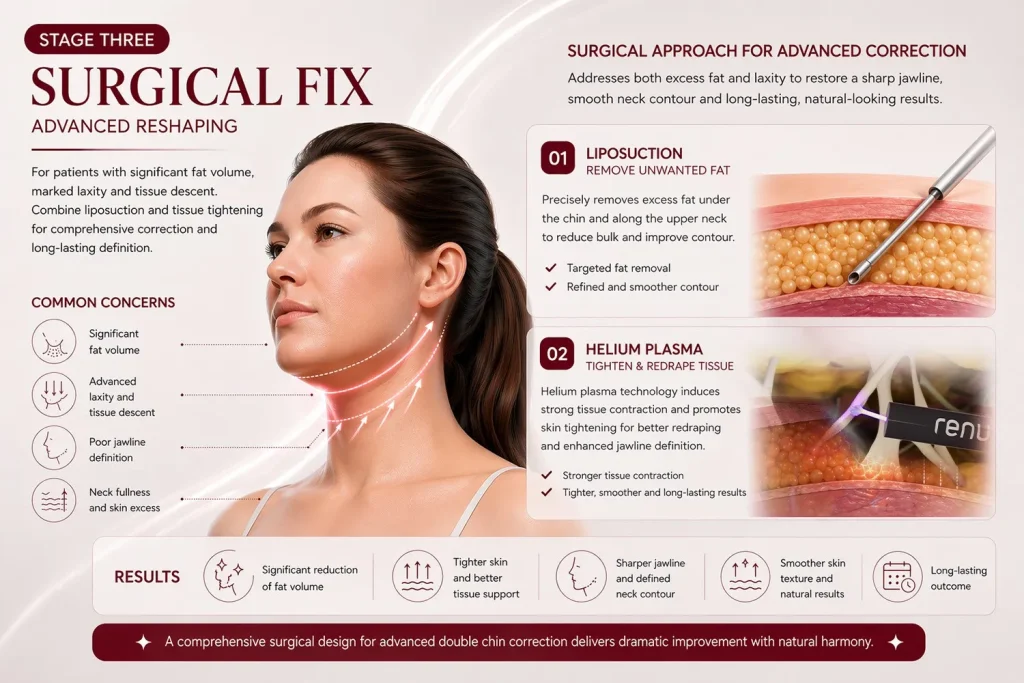
In more advanced cases, the double chin is no longer a small isolated concern. It becomes part of a broader lower-face and neck problem involving significant fat volume, tissue hanging, skin excess, and loss of definition extending beyond the chin itself.
At this stage, conservative treatment is often not enough to create meaningful correction.
This is where surgical design may offer the most complete solution.
For patients with heavier fat accumulation together with marked tissue descent, liposuction combined with helium plasma technology may provide a more comprehensive approach — addressing both excess volume and the need for tighter tissue redraping afterwards.
This is one of the most important principles in advanced double chin correction: removing volume alone does not automatically restore contour. If the tissue is loose, reduction without support may leave the area smaller, but not necessarily sharper. Likewise, tightening without adequately addressing fat may still leave the jawline undefined.
In advanced cases, what is required is not simply a stronger procedure, but a more complete treatment design.
That means assessing facial proportion, skin elasticity, tissue thickness, and the severity of descent before deciding how correction should be performed. Even at the surgical level, the goal is not to make the face look aggressively treated, but to make it look cleaner, more balanced, and more naturally resolved.
Surgery, then, is not the opposite of design. It is simply a more advanced expression of it.
Why Better Results Come From Better Decisions
One of the most important messages in modern aesthetics is that the best results do not come from using more devices. They come from making better decisions.
Patients often ask for the latest machine or the most advanced technology, assuming that innovation alone guarantees superiority. But in reality, even excellent technology can underperform if it is chosen for the wrong anatomy or the wrong stage of the problem.
This is especially true in double chin treatment, where similar-looking concerns may have very different structural causes underneath. Without proper analysis, treatment can easily become either insufficient or excessive.
The most expert approach is therefore not to begin with a machine, but with judgment.
Sometimes the right answer is non-surgical refinement. Sometimes it is minimally invasive internal lifting. Sometimes it is surgical correction. And sometimes the most responsible answer is to explain honestly that a lighter treatment will not achieve the patient’s real goal.
That level of discernment is what defines expert-led aesthetic planning.
The Final Word
Double chin may be one of the most common aesthetic concerns today, but it is also one of the most misunderstood.
What appears simple on the surface is often more complex underneath. Fat may be part of the problem. So may laxity, tissue descent, loss of support, or inherited structure. That is why meaningful correction can never be reduced to a single device or a universal formula.
The future of treatment lies in staging the problem correctly, designing the correction appropriately, and selecting the right intervention for each individual face.
Because in modern aesthetic medicine, the best results do not come from using more technology.
They come from using the right design.